Roth IRA vs Traditional IRA: Which Is Better for You? (2026)
The Roth IRA vs Traditional IRA question is one of the most important retirement decisions you'll make. The right answer depends on your current tax bracket, expected retirement income, and age — here's how to decide.
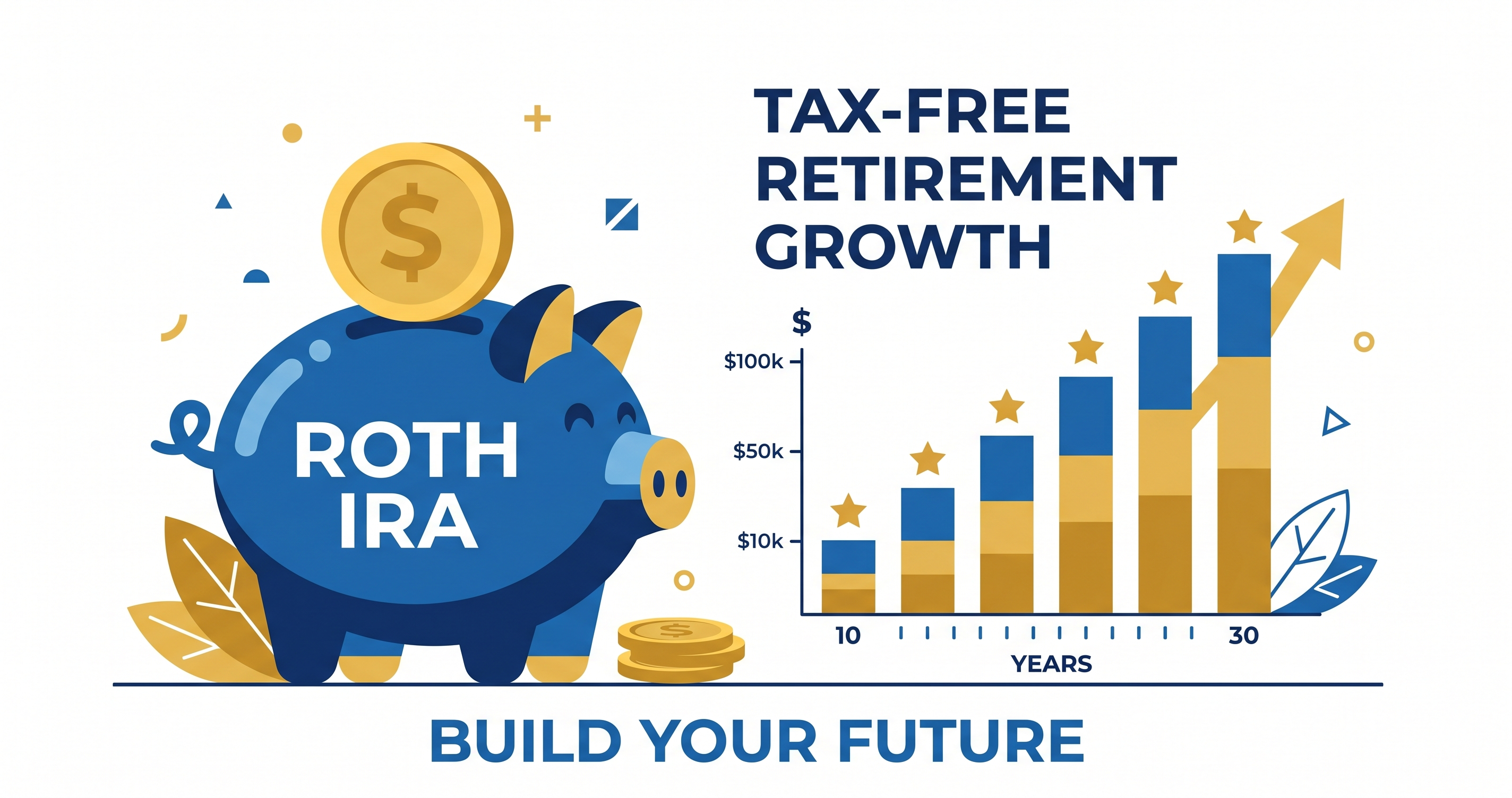
See exactly how much your contributions grow tax-free by retirement.
Roth IRA Calculator →The Key Difference: When You Pay Taxes
Both accounts grow your investments tax-deferred, but they differ in when you pay taxes:
| Feature | Roth IRA | Traditional IRA |
|---|---|---|
| Tax on contributions | After-tax (no deduction) | Pre-tax (may be deductible) |
| Tax on withdrawals | Tax-FREE | Taxed as income |
| 2026 contribution limit | $7,000 ($8,000 age 50+) | $7,000 ($8,000 age 50+) |
| Income limits | Yes (phase out $146K–$161K single) | No limit to contribute; deductibility has limits |
| Required Minimum Distributions | None | Required from age 73 |
| Early withdrawal of contributions | Any time, penalty-free | 10% penalty before 59½ |
Choose Roth IRA If…
- You are young (under 40) — more time for tax-free compounding to work
- Your current tax rate is lower than you expect in retirement
- You earn below $100,000/year (likely in a lower bracket now than at retirement peak)
- You want flexibility — contributions can be withdrawn any time without penalty
- You want to leave money to heirs — no RMDs, grows tax-free indefinitely
- You already have a 401(k) or Traditional IRA — Roth provides tax diversification
Choose Traditional IRA If…
- You're in a high tax bracket now (32%+) and expect lower income in retirement
- You need the immediate tax deduction to reduce this year's taxable income
- You earn above the Roth income limit ($161,000 single / $240,000 married in 2026)
- You expect your retirement expenses to be modest — lower income = lower tax bracket in retirement
Real Example: Which Saves More?
Let's say you're 30 years old, earn $65,000/year (22% federal tax bracket), and contribute $6,000/year until age 65 at 7% annual return.
Traditional IRA path: Deduct now → $6,000 pre-tax contributions → $887,000 at 65 → pay 22% tax on withdrawals → keep ~$691,000
Roth advantage: ~$196,000 more (assuming same tax rate — advantage grows if your retirement bracket is higher)
Use our Roth IRA Calculator to see the numbers for your specific age, contribution, and return rate.
Can I Have Both?
Yes — you can contribute to both a Roth and Traditional IRA in the same year, as long as your total contributions don't exceed $7,000 ($8,000 if 50+). Many financial advisors recommend "tax diversification" — having both types so you can choose which to draw from in retirement based on your tax situation that year.