How to Calculate Compound Interest Manually — Formula, Examples & Free Calculator (2026)
Compound interest is the most powerful force in personal finance. This guide shows you exactly how to calculate it manually using the formula, with step-by-step examples for monthly, quarterly, and yearly compounding — plus a free calculator for instant results.
Enter your principal, rate, and years to instantly see compound interest results with a full year-by-year breakdown.
Open Compound Interest Calculator →What Is Compound Interest?
Compound interest means you earn interest not just on your original money (the principal), but also on the interest you have already earned. Each period your interest gets added to your balance, and the next period's interest is calculated on that larger amount.
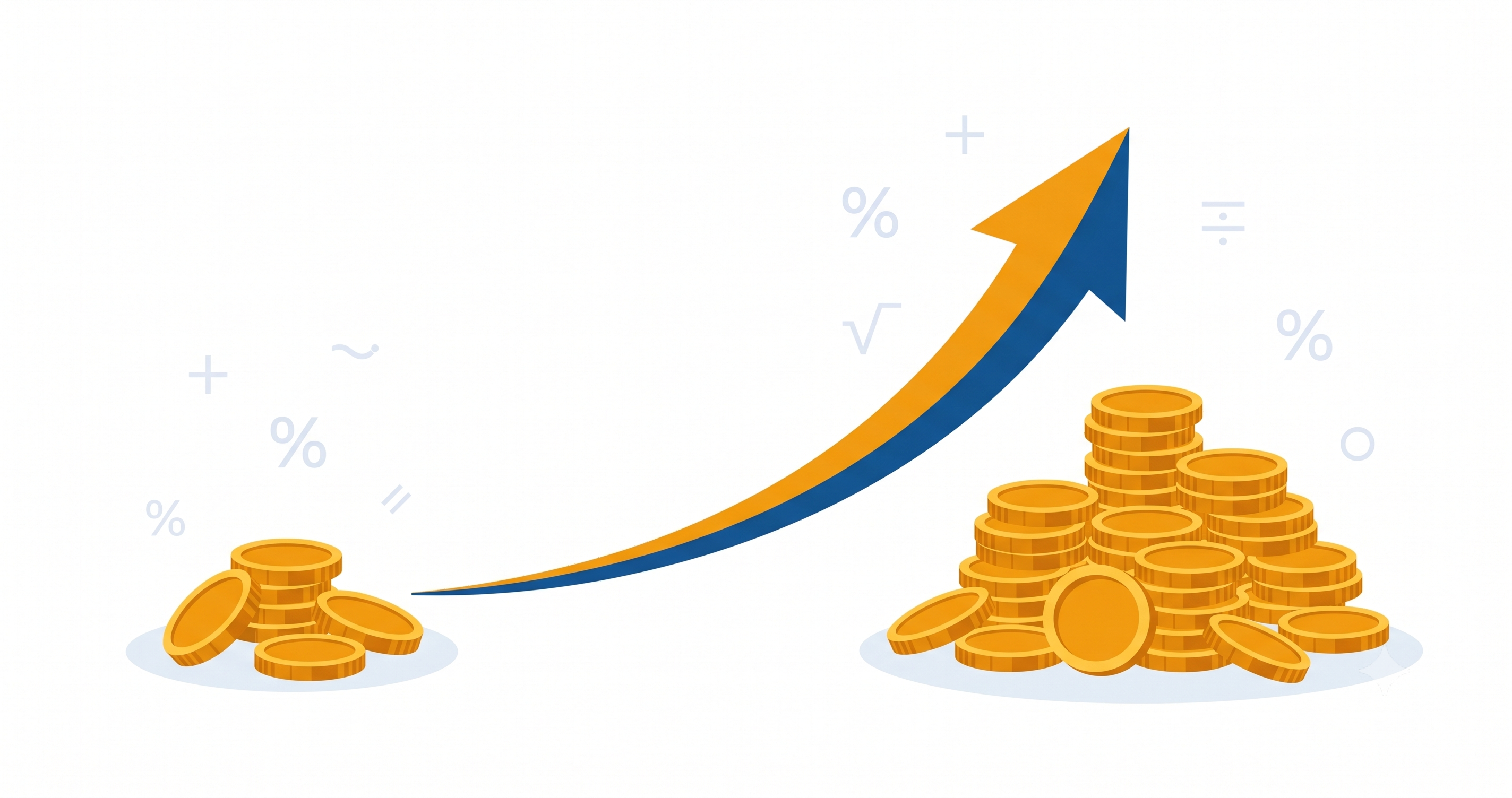
This creates an exponential growth curve — slow at first, then dramatically faster over time. It is why starting to save early makes such an enormous difference, and why carrying high-interest debt is so dangerous.
| Type | Calculated On | Growth Pattern |
|---|---|---|
| Simple Interest | Original principal only | Linear (straight line) |
| Compound Interest | Principal + accumulated interest | Exponential (curves upward) |
The Compound Interest Formula
| Variable | Meaning | Example |
|---|---|---|
| A | Final amount (what you want to find) | ? |
| P | Principal (starting amount) | $5,000 |
| r | Annual interest rate as decimal | 6% = 0.06 |
| n | Compounding periods per year | 12 = monthly |
| t | Time in years | 10 |
To find interest earned only: Interest = A − P
Compounding Frequency — What Does n Equal?
| Compounding Period | n value | Common Use |
|---|---|---|
| Annually | 1 | Bonds, some savings accounts |
| Quarterly | 4 | Some CDs, investments |
| Monthly | 12 | Savings accounts, mortgages, credit cards |
| Daily | 365 | High-yield savings accounts |
Step-by-Step Examples
Example 1 — Annual Compounding (Simplest)
$3,000 at 5% annual interest for 4 years
- r/n = 0.05 ÷ 1 = 0.05
- 1 + 0.05 = 1.05
- n × t = 1 × 4 = 4
- 1.05&sup4; = 1.2155
- $3,000 × 1.2155 = $3,646.52
Interest earned = $3,646.52 − $3,000 = $646.52
Example 2 — Monthly Compounding (Most Common)
$10,000 at 4.5% compounded monthly for 3 years
- r/n = 0.045 ÷ 12 = 0.00375
- 1 + 0.00375 = 1.00375
- n × t = 12 × 3 = 36
- 1.00375³&sup6; = 1.14423
- $10,000 × 1.14423 = $11,442.30
Interest earned = $1,442.30
Example 3 — Daily Compounding (High-Yield Savings)
$5,000 at 5.0% compounded daily for 2 years
- r/n = 0.05 ÷ 365 = 0.0001370
- 1 + 0.0001370 = 1.0001370
- n × t = 365 × 2 = 730
- 1.0001370&sup7;³&sup0; = 1.10517
- $5,000 × 1.10517 = $5,525.85
Interest earned = $525.85
$1,000 Growth Table — Different Rates Over Time
| Years | 3% | 5% | 7% | 10% |
|---|---|---|---|---|
| 5 | $1,159 | $1,276 | $1,403 | $1,611 |
| 10 | $1,344 | $1,629 | $1,967 | $2,594 |
| 20 | $1,806 | $2,653 | $3,870 | $6,727 |
| 30 | $2,427 | $4,322 | $7,612 | $17,449 |
| 40 | $3,262 | $7,040 | $14,974 | $45,259 |
At 7% (average stock market return), $1,000 becomes $7,612 in 30 years — without adding a single extra dollar. Try any amount with our compound interest calculator.
Simple vs Compound Interest — Real Dollar Difference
On $10,000 at 6% for 20 years:
| Simple Interest | Compound (Annual) | Difference | |
|---|---|---|---|
| Final Amount | $22,000 | $32,071 | +$10,071 |
| Interest Earned | $12,000 | $22,071 | 84% more |
The Rule of 72 — Mental Math Shortcut
- At 6%: 72 ÷ 6 = 12 years to double
- At 8%: 72 ÷ 8 = 9 years to double
- At 24% (credit card): 72 ÷ 24 = 3 years for debt to double!
Credit card debt compounding against you is just as powerful. See our credit card debt payoff guide to stop it.
When Compound Interest Works For You vs Against You
Works FOR You ✅
- 401(k) / IRA: Tax-deferred compounding for decades
- High-yield savings: Daily compounding at 4–5% APY in 2026
- Index funds: Reinvested dividends compound your returns
Works AGAINST You ❌
- Credit cards: 20–30% APR compounding monthly on unpaid balances
- Student loans: Interest capitalizes during deferment periods
- Personal loans: High-rate debt grows fast on minimum payments only
For your full retirement projection, use our retirement calculator. To understand your savings rate, see our savings rate guide.
Any amount, rate, and timeframe — get a full year-by-year breakdown instantly.
Try the Free Calculator →