What is a Normal BMI in 2026? Healthy Range, Charts & What Your Number Means
A normal BMI is 18.5 to 24.9 — but what does your specific number mean, and how does it translate to actual pounds at your height? Here is everything you need to know, with real numbers for every height.
Enter your height and weight for your exact BMI, what category you fall in, and your complete healthy weight range.
Calculate My BMI →What is a Normal BMI?
According to the CDC and World Health Organization, a normal (healthy) BMI is 18.5 to 24.9 for adults. This range is the same for men and women and applies to all adults aged 20 and older.
Here is the full BMI classification table:
| BMI Range | Category | What It Means |
|---|---|---|
| Below 18.5 | Underweight | May indicate nutritional deficiency or health issue |
| 18.5 – 24.9 | Normal / Healthy ✓ | Lowest risk of chronic disease |
| 25.0 – 29.9 | Overweight | Moderately increased health risk |
| 30.0 – 34.9 | Obese Class I | High health risk — doctor consult advised |
| 35.0 – 39.9 | Obese Class II | Very high health risk |
| 40.0+ | Obese Class III | Extremely high risk — medical care needed |
What is the Ideal BMI Within the Normal Range?
While any BMI from 18.5 to 24.9 is "normal," research points to BMI 21 to 22 as the optimal sweet spot. Studies tracking hundreds of thousands of adults show the lowest rates of heart disease, diabetes, and early death cluster around this midpoint.
Being near the lower end (18.5–19.5) is healthy but leaves little buffer. Being near the upper end (24–24.9) is still normal but close to the overweight border. The middle of the range — BMI 21 to 23 — offers the best position from a purely statistical standpoint.
Normal BMI by Height — What Does It Actually Weigh?
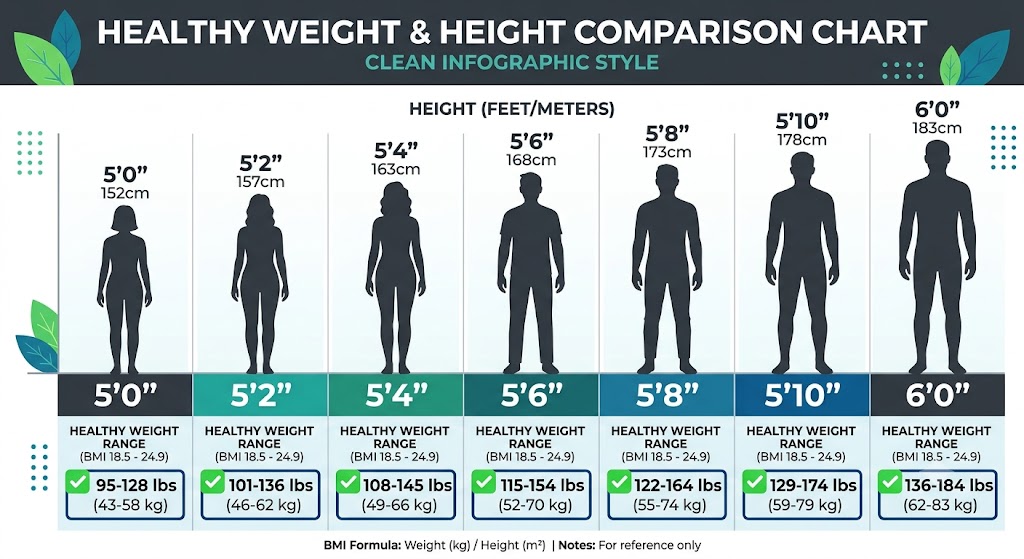
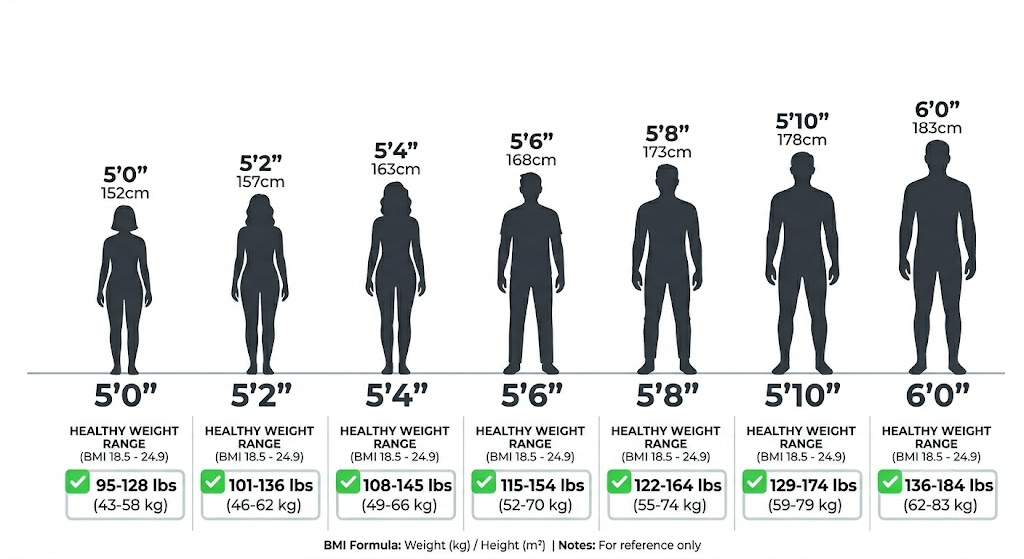
BMI 18.5–24.9 means very different things depending on your height. Here is the complete breakdown:
| Height | Underweight (Below 18.5) |
Normal Weight (18.5–24.9) |
Overweight (25–29.9) |
Obese (30+) |
|---|---|---|---|---|
| 5'0" | Under 94 lbs | 94–127 lbs | 128–153 lbs | 154+ lbs |
| 5'1" | Under 97 lbs | 97–132 lbs | 133–158 lbs | 159+ lbs |
| 5'2" | Under 101 lbs | 101–136 lbs | 137–163 lbs | 164+ lbs |
| 5'3" | Under 104 lbs | 104–140 lbs | 141–168 lbs | 169+ lbs |
| 5'4" | Under 108 lbs | 108–145 lbs | 146–174 lbs | 175+ lbs |
| 5'5" | Under 111 lbs | 111–149 lbs | 150–179 lbs | 180+ lbs |
| 5'6" | Under 115 lbs | 115–154 lbs | 155–185 lbs | 186+ lbs |
| 5'7" | Under 118 lbs | 118–159 lbs | 160–191 lbs | 192+ lbs |
| 5'8" | Under 122 lbs | 122–164 lbs | 165–197 lbs | 198+ lbs |
| 5'9" | Under 125 lbs | 125–169 lbs | 170–203 lbs | 204+ lbs |
| 5'10" | Under 129 lbs | 129–174 lbs | 175–209 lbs | 210+ lbs |
| 5'11" | Under 133 lbs | 133–179 lbs | 180–214 lbs | 215+ lbs |
| 6'0" | Under 136 lbs | 136–184 lbs | 185–220 lbs | 221+ lbs |
| 6'1" | Under 140 lbs | 140–189 lbs | 190–226 lbs | 227+ lbs |
| 6'2" | Under 144 lbs | 144–194 lbs | 195–233 lbs | 234+ lbs |
For your exact number, use our free BMI calculator — it shows your precise BMI and the full healthy weight range for your specific height in seconds.
Normal BMI for Women vs Men — Is There a Difference?
The CDC uses the same BMI categories for men and women. However, biology creates real differences in what those numbers mean:
- Women naturally carry 5–10% more body fat than men at the same BMI. A woman at BMI 22 typically has about 25–28% body fat. A man at BMI 22 has about 15–18% body fat.
- Men with significant muscle mass often show BMI 25–27 despite having low body fat. For active men, waist circumference (under 40 inches) is a better health indicator than BMI alone.
- Older adults (65+) may actually be healthier at BMI 23–28 than at the standard 18.5–24.9. Research shows slightly higher BMI is protective in older age — a phenomenon called the "obesity paradox."
How to Calculate Your BMI
The BMI formula in US units is:
BMI = (Weight in lbs × 703) ÷ (Height in inches)²
Example: 5'5" person (65 inches) weighing 145 lbs:
- 145 × 703 = 101,935
- 65² = 4,225
- 101,935 ÷ 4,225 = BMI 24.1 — normal range ✅
Or skip the math entirely — our BMI calculator does it instantly in both US and metric units.
Normal BMI Does Not Tell the Whole Story
BMI is a useful screening tool but has real limitations. It does not measure:
- Muscle vs fat: A fit person at BMI 26 may be far healthier than a sedentary person at BMI 22
- Where fat is stored: Belly fat (visceral fat) raises disease risk much more than hip or thigh fat at the same BMI
- Bone density: Larger bone structure raises BMI without raising health risk
- Fitness level: Cardiorespiratory fitness is a stronger predictor of longevity than BMI in many studies
For a more complete picture, combine BMI with waist circumference (under 35" for women, under 40" for men) and basic blood markers like fasting blood sugar, blood pressure, and cholesterol.
What If Your BMI Is Not in the Normal Range?
If You Are Underweight (BMI below 18.5)
Underweight can indicate malnutrition, an underlying health condition, or disordered eating. If your BMI is below 18.5, especially below 17.5, speaking with a doctor is the right move. Gaining weight through increased caloric intake and strength training is the typical approach.
If You Are Overweight (BMI 25–29.9)
Being in this range slightly increases your risk for type 2 diabetes, heart disease, and joint problems. The good news: losing just 5–10% of your body weight meaningfully reduces these risks. For a 180 lb person, that is only 9–18 lbs. Use our calorie calculator to find your daily target for sustainable weight loss.
If You Are Obese (BMI 30+)
BMI 30+ is associated with significantly elevated health risks. Medical consultation is recommended. Even modest weight loss — 5 to 10% of body weight — improves blood pressure, blood sugar, and cholesterol substantially, even without reaching the "normal" BMI range.
Enter your height and weight — get your exact BMI, category, and the healthy weight range for your height in both lbs and kg.
Calculate BMI Now →